AI agents are getting better at handling real work. They can write code, draft emails, triage support, summarize research, and keep moving while people do other things.
So why does it still feel like human work is expanding instead of disappearing?
Because automation is not just removing effort. It is also creating more output, more options, more decisions, and more pressure to choose what matters. That changes the job. It does not erase it.
The most useful way to think about modern AI is not “replace the worker.” It is restructure the workflow. The best results now tend to come from a mix of delegated agent work and active human steering.
What has changed in the way people use AI agents
The old pattern was simple. Type a prompt, wait for an answer, review it, then send the next prompt.
The newer pattern is different. People increasingly launch agents to do work on their behalf, often across multiple threads and tasks. That might mean drafting, searching, coding, comparing options, or handling routine service interactions.
But the real shift is not just more autonomy. It is managing ongoing work instead of requesting one-off outputs.
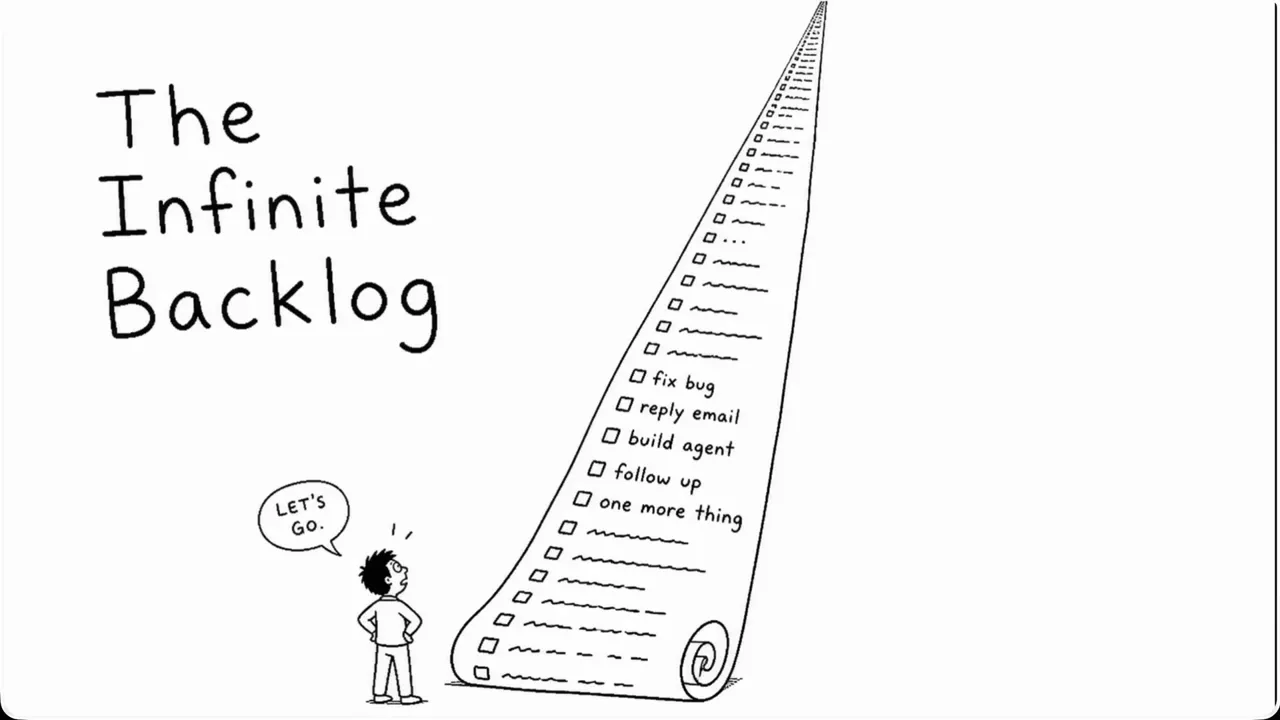
That sounds efficient, and it is. It also creates a new problem: if agents can always do another task, there is always another task to assign.
The real bottleneck is no longer typing. It is deciding.
As AI gets cheaper and more capable, execution becomes less scarce. Judgment becomes more scarce.
That includes:
Choosing the right task
Framing what “good” looks like
Providing company context
Spotting errors, sameness, or weak reasoning
Deciding what should happen next
This is why many teams report a strange result: they automate aggressively, yet still feel like there is more work to do.
More capability creates more possible projects. More projects create more decisions. More decisions create more need for people who can steer.
Why automation can create more human work
This sounds backwards until you break it down.
1. AI makes yesterday's expertise cheap
Models are trained on the visible residue of past work: code, writing, images, support interactions, specs, and similar artifacts. That means many tasks that used to require a specialist are now accessible to far more people.
Operations people can write code. Marketers can create visual assets. Engineers can draft marketing copy. Customer support can be partially handled by embedded agents.
That is a real productivity gain.
2. Cheap capability increases supply
When many more people can produce competent work, output explodes. There is more content, more software, more drafts, more tickets resolved, more experiments launched.
This is where many leaders stop the analysis. They assume the next step is fewer humans.
3. More supply creates more sameness
When everyone has access to similar models, default output starts to converge. Work becomes easier to produce, but also easier to confuse, ignore, or dismiss.
The problem is not one telltale phrase or one formatting habit. The problem is visible sameness. A lot of work starts to feel interchangeable.
4. Sameness increases demand for difference
That difference usually comes from humans. Not because machines are useless, but because differentiated work depends on taste, context, live priorities, tradeoffs, originality, and accountability.
In other words, when baseline competence becomes abundant, judgment and distinctiveness become more valuable.
The two most useful modes of working with agents
Not all agent workflows are the same. Two broad patterns are emerging.
Agents as employees
These agents are delegated tasks and return a result. They are good for repeatable, well-framed work.
Examples include:
A Slack-based agent you can tag for a report or first draft
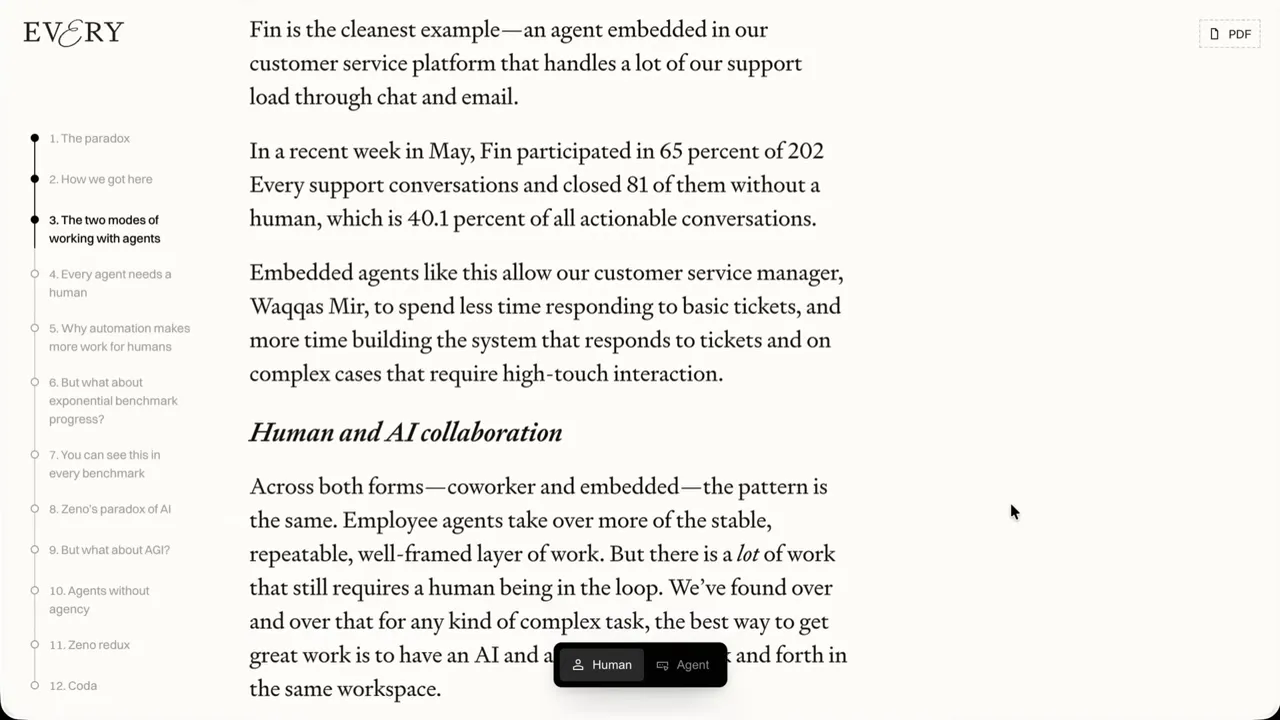
A support agent embedded in chat or email workflows
An internal research or analytics assistant that performs recurring tasks
This pattern works best when the task is stable and the expected output is clear.
Humans and agents working in the same workspace
This is the more interesting pattern for complex knowledge work.
Instead of sending work away and waiting, the human and agent operate in the same environment. The person can launch multiple threads, inspect what the agent is doing, interrupt, redirect, compare approaches, and evaluate partial outputs as they emerge.
Tools in the Codex and Claude Code category point toward this style of work. The agent is not just a remote helper. It becomes part of the working environment itself.
This matters because many tasks are not truly “one shot.” They need back-and-forth, course correction, and live context.
The human sandwich model
One practical way to understand this is the human sandwich.
It works like this:
Human sets the frame. Define the goal, context, constraints, and standard for success.
Agent compresses the labor. Draft, search, compare, code, summarize, or triage.
Human judges and extends. Decide what is useful, what is wrong, what is missing, and what should happen next.
The agent does the heavy middle. The human owns the beginning and the end.
That pattern shows up in coding, writing, support, operations, and strategy work. It is not a niche workflow. It is becoming a default one.
Why fully autonomous agents often disappoint
Early excitement around always-on autonomous agents pushed toward a simple dream: give an agent tools, let it run continuously, and check in later.
That approach can work in narrow cases. But in practice it introduces several problems.
Maintenance overhead
Agents need setup, supervision, and repair. When everyone has their own customized agent, the maintenance burden spreads across the whole team.
That works for people who love tinkering. It works much less well for everyone else.
Managerial overhead
Higher autonomy does not remove management. It often increases it. Someone still has to notice drift, inspect results, provide context, and decide the next task.
Token and cost burn
Highly autonomous workflows can consume large amounts of compute. In a world where advanced model usage is costly and capacity is constrained, unnecessary autonomy is not just messy. It is expensive.
Weak fit for original work
Complex work usually benefits from quick clarification and iteration. If feedback loops are too slow, quality drops.
This is why many teams are landing in a middle ground. They want more autonomy than plain chat, but more control than a barely supervised always-on agent.
Why shared team agents often beat personal agents
One of the more useful organizational lessons so far is that shared agents can outperform personal ones.
At first, it seems natural for every employee to have their own digital counterpart. The problem is that personal agents do not scale cleanly.
When each person owns their own agent:
Each agent must be maintained separately
Useful upgrades have to be repeated
Knowledge stays fragmented
Continuity breaks when the owner leaves
Shared team agents solve a lot of this.
For example, a common analytics agent used by multiple functions can improve once and benefit everyone. A support agent embedded in one workflow can handle recurring requests consistently. An editorial or research agent can serve a whole team instead of one enthusiast.
This is not just an efficiency play. It is a better operating model.
A simple way to find good shared-agent opportunities
Look for overlap in jobs rather than trying to automate each role from scratch.
Ask:
Where do multiple teams touch the same information?
Which tasks repeat across functions?
Where does work get reformatted, summarized, or handed off?
Which tasks are stable enough to define clearly?
That overlap is often the best place to put a shared agent.
|
What good human-agent collaboration looks like in practice
The strongest workflows today usually share a few traits.
Low-latency steering
The shorter the gap between noticing an issue and redirecting the agent, the better the output. That is why people increasingly want agent access across devices and in more continuous workflows.
Parallel threads
Instead of one long chat, better setups let you run multiple tasks at once, compare paths, and return to them as needed.
Interruptibility
You need to be able to stop, redirect, or refine a task midstream. If the only options are “wait” or “restart,” you lose a lot of value.
Visible work in progress
When you can inspect what the system is doing, you can intervene sooner and trust the result more.
Clear handoff points
The workflow should make it obvious when the human needs to step in: framing the task, approving a draft, choosing among options, or assigning the next job.
Common mistakes teams make with AI agents
1. Treating agents like magic employees
Agents need structure. If the task is vague, the output usually reflects that vagueness.
2. Optimizing only for labor savings
The bigger upside is often growth, not just efficiency. AI expands what a team can attempt. Focusing only on headcount reduction misses much of the opportunity.
3. Giving everyone their own custom setup
This creates fragmented maintenance and uneven outcomes.
4. Ignoring quality drift
Default output can be fine until everyone starts using the same defaults. Then the work gets harder to differentiate.
5. Leaving humans out of the final judgment
Even strong agent output still needs someone to decide whether it is right, useful, timely, and appropriate.
Does this mean AI will create more jobs than it eliminates?
No one can answer that with certainty yet. Short-term displacement in some roles remains possible.
But there is a strong case that AI increases the total amount of valuable work available, especially when organizations use it to expand output rather than only cut cost.
That argument is gaining traction beyond AI enthusiasts. Gartner has argued that AI is likely to create more jobs than it eliminates over time, even if some layoffs appear in the transition.
What matters most for companies is how they respond.
The winners are likely to be the ones that:
Invest in their teams' ability to use and manage agents
Build workflows around shared systems, not isolated experiments
Use AI to pursue growth, not just efficiency
Keep humans responsible for judgment, differentiation, and direction
For supporting context, see Gartner's coverage on AI and employment trends at Gartner.
What this means for individual workers
If you work with knowledge, the job is shifting from doing every step yourself to orchestrating systems that can help you do more.
That means the durable skills are not disappearing. They are moving.
The valuable skills increasingly include:
Problem framing
Taste and editorial judgment
Prioritization
Cross-functional context
Communication
Ability to supervise and refine machine output
The person who can manage multiple agent threads well may outperform the person who tries to do everything manually. But the person who can direct them toward the right goals will outperform both.
A practical checklist for adopting agents without creating chaos
If you are experimenting now, start here:
Pick one repeated workflow. Choose something stable, not your hardest edge case.
Define success before automation. If humans cannot explain what good looks like, the agent will struggle too.
Prefer shared agents for shared work. Centralize maintenance where possible.
Keep humans at the start and finish. Use the human sandwich model.
Reduce feedback latency. Make it easy to steer agents mid-task.
Measure quality, not just speed. Faster bad output is still bad output.
Watch for sameness. If everything starts looking interchangeable, human review needs to increase.
The takeaway
AI agents still need humans because work is not just execution.
Work is choosing goals, defining standards, handling ambiguity, spotting what is novel, and deciding what matters now.
Agents are very good at compressing labor. Humans are still essential for framing, taste, and judgment. The next wave of AI work is not full replacement. It is tighter collaboration.
And for most teams, the best opportunity is not asking how to get humans out of the loop. It is figuring out where the human should stay in the loop to make the whole system better.
